
Canada’s Trade Future Starts Here

Updated: Jul 21, 2025
How the TransPacific Trade Nexus (TPTN) is solving the real problems holding SMEs back

The Problem Canada Can’t Keep Ignoring
Canada sends over 70% of its exports to one country. It’s been that way for decades. And while our southern neighbour remains a vital partner, it also represents a single point of failure. Tariffs, political volatility, protectionist policies—any one of these can slam the brakes on SME growth overnight.
But the real issue isn’t just dependency—it’s infrastructure.
Our exporters face a global playing field with no digital support. Compliance is manual. Logistics are fragmented. Documentation is a nightmare. Most SMEs are still piecing together export workflows using PDFs, email chains, and blind trust. The tools just haven’t evolved. And no one’s building for them.
This isn’t a new problem. It’s just one we’ve tolerated too long.
Why I Built TPTN: 25 Years of Trade Pain
In 1998, I was managing shipments between North America and Asia—faxing 50-page spec sheets back and forth, praying the factory existed, and hoping the goods matched the bill. I’ve seen trade from the ground: rail disruptions, market bans, supplier collapses, currency shocks, you name it.
Fast forward 25 years, and we’re still there.
That’s why, in the summer of 2023, I started asking harder questions. Why hasn’t anyone built infrastructure that actually works for Canadian exporters? Why do SMEs still struggle with the same frictions—compliance, language, trust, and logistics?
That search became a blueprint. That blueprint became TPTN.
Now, after 24 months of design, validation, and coalition-building, we’re deploying what Canada has needed for decades: an AI-native trade infrastructure platform that simplifies, secures, and scales SME exports—starting with ASEAN.
From Concept to Catalyst: The TPTN Journey
TPTN was conceived well before Trump re-emerged on the protectionist stage. But his return—along with rising instability and nearshoring chatter—has only made the mission more urgent.
What started as a founder-led, lived-experience deep dive has grown into a nationally recognized infrastructure initiative:
4 provinces (Alberta, Manitoba, Saskatchewan, Nova Scotia) have issued formal support letters
Digital Governance Council validation confirms alignment with MLETR
IRAP onboarding and prototype co-development with Quebec AI partner Spiria now underway
Federal, ASEAN, and trade ecosystem engagement accelerating
This isn’t theory. We’re executing.
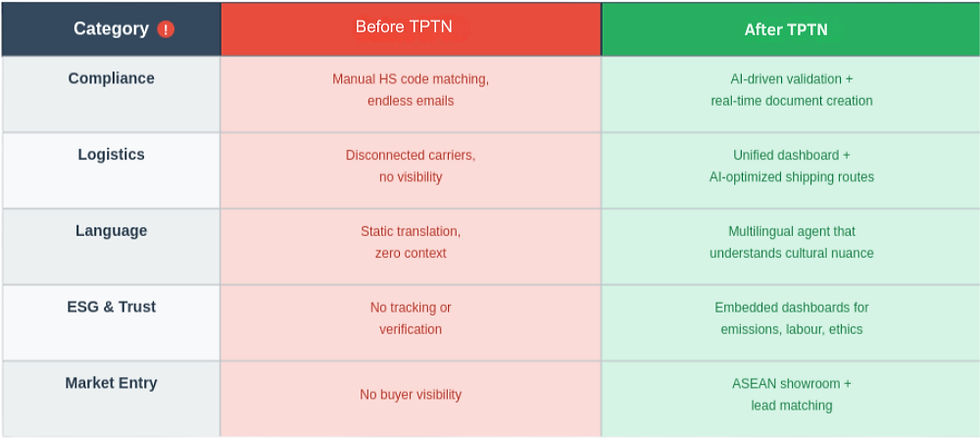
The Exporter Journey: Before TPTN vs. After TPTN
What TPTN Actually Delivers
This is infrastructure—not a one-off SaaS tool. TPTN is modular, scalable, and designed to plug into real-world workflows across the export lifecycle.
🔹 AI Compliance Engine
Validates HS codes, applies Free Trade Agreement logic, flags errors, and generates clean, standards-aligned documents (UNCITRAL MLETR-compliant). No guesswork. No lawyers on speed dial.
🔹 Multilingual AI Trade Agent
Not just translation—intent and nuance. Our agent helps exporters navigate foreign requests, documentation, and buyer negotiations in culturally accurate language.
🔹 ESG & Risk Dashboards
Tracks emissions, labour standards, and ESG flags by shipment—making compliance and sustainability practical, not performative.
🔹 ASEAN Showroom
Digital gateway that allows ASEAN buyers to browse and verify Canadian SME offerings—closing the visibility gap flagged by EDC and regional stakeholders.
🔹 Trade Finance Integration
Smart invoicing, credit insurance APIs, and embedded financing logic designed to unlock capital for growth—not bureaucracy.
🔹 Customs & Government Interfaces
Secure dashboards and APIs for real-time customs processing, audit-readiness, and data sharing with trusted public agencies.
Built in Canada, for Canadian exporters
Validated for MLETR compliance by the Digital Governance Council (DGC) and aligned with CAN/DGSI 104:2024, Canada’s cybersecurity governance standard. Currently progressing through IRAP onboarding.
Why ASEAN? And Why Now?
ASEAN isn’t emerging—it’s already here. With over 660 million people and a combined GDP topping $3.6 trillion, the region is digitizing faster than any other bloc. By 2030, its digital economy is projected to surpass $2 trillion.
Canada has signed FTAs like CPTPP and is aiming to finalize a Canada–ASEAN agreement by the end of 2025. But policy alone won’t unlock opportunity. Execution will.
TPTN translates these agreements into usable, automated workflows—ensuring that trade doesn’t stay on paper but moves in practice. This is how we level the field for SMEs and reclaim Canada’s relevance in a fast-changing global landscape.
The Infrastructure Canada Has Been Missing
For too long, we’ve focused on funding trade shows, issuing export guides, and launching disconnected tools. Meanwhile, our competitors are building systems.
TPTN is Canada’s chance to do things differently:
Build trust through transparency, automation, and accountability
Deliver real tools that reflect Canadian values—privacy, inclusion, sustainability
Position ourselves not just as exporters, but rule-setters in global digital trade
Momentum and Next Steps
The prototype is now in build with Spiria in Quebec, targeting the Exporter module and Multilingual Trade Agent as priorities. ESG and FTA intelligence features are layered in early. Pilot activations are scheduled to begin Fall 2025, with national scaling into 2026.
We’re already seeing strategic traction:
Provinces are engaging.
ASEAN stakeholders are ready.
Canada is at a crossroads.
The only question left is: do we lead, or do we wait for someone else to define the rails?
🚀 Let’s Build Canada’s Trade Future—Together
If you’re a Canadian SME, policy partner, government buyer, investor, or trade organization—we’re not waiting for permission. We’re building infrastructure that works. Canada’s trade future starts here.
This is Canada’s moment to lead. Let’s build something that lasts.
📩 Get in touch: chris@synergai.ai
🔗 Follow TPTN: LinkedIn – Chris Papp | TPTN LinkedIn Page


Comments